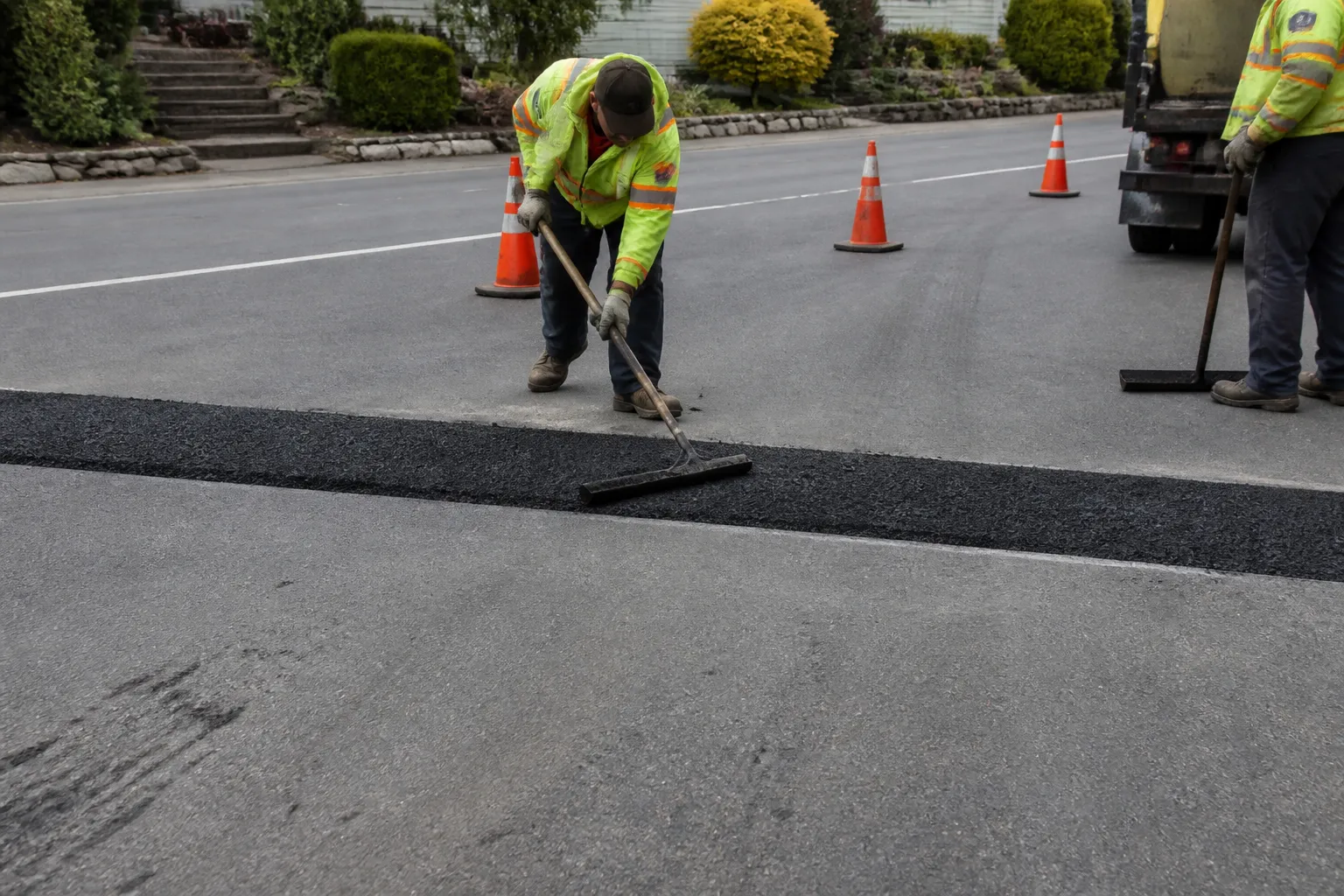
Kennewick Asphalt Paving provides Utility Cut Repair in Kennewick, WA for property owners in Kennewick, WA and the Tri-Cities.
Utility cut repair is appropriate after water, sewer, electrical, communications, irrigation, or other underground work has opened a paved surface and the disturbed area is ready to be restored. A trench may be narrow, but uneven settlement, crumbling edges, loose aggregate, and a rough driving line can turn a completed utility project into a continuing pavement concern.
Kennewick Asphalt Paving restores asphalt around completed utility cuts on suitable private-property surfaces in Kennewick and the Tri-Cities. Work is planned around cut width, depth, backfill condition, adjoining pavement, and traffic crossing the repair. The objective is a stable asphalt restoration with a sensible connection to surrounding surface, not merely a dark strip placed over a disturbed trench.
This service is commonly needed after a contractor or property owner has completed below-ground access and the trench has been properly backfilled. It may apply to a residential driveway crossing, parking-lot utility route, private road connection, or service lane behind a commercial building. Repair is most effective once excavation and required inspections are complete.
If backfill is still moving, wet, incomplete, or subject to additional utility work, paving too soon may not be appropriate. Readiness below the surface is central to the evaluation.
A prepared repair can replace broken asphalt at the cut edges, smooth a sharp transition, and close gaps where water can enter. It can restore a drivable route where temporary material is unsuitable for traffic. When a trench crosses marked parking spaces or traffic lanes, restoration may be paired with a discussion about repainting affected markings afterward.
Settlement is often related to changing support below pavement. A new asphalt cap cannot correct deeply unstable material by itself. The scope should reflect whether the exposed area has sound, compacted support before surface restoration.
The cut line is not always the full repair boundary. Saw-cut damage, traffic, or water can leave adjacent asphalt weakened. Extending the repair to stable pavement creates a sounder edge than tying new material into crumbled fragments.
Utility cut repair begins with a close look at the trench and nearby pavement. We establish a clean repair boundary, remove failed asphalt, and assess the top of the backfilled area. Aggregate base is corrected or re-compacted where appropriate before new pavement is placed. Fresh hot-mix asphalt is installed and compacted to form a practical connection.
For homeowners, a utility cut may cross a driveway after water-line, sewer-line, electrical, or irrigation work. The concern is restoring a smooth path to the garage and avoiding a patch that breaks apart in wheel tracks. Gates, landscaping, existing concrete, and access affect the work plan.
Commercial properties may have longer cuts through parking rows, fire lanes, service drives, or loading routes. These require attention to vehicle movement, business access, striping, and heavier wheel loads. Work may be sequenced around active operations so a usable route remains where possible.
Visible trench length does not tell the full story. Scope can be affected by width, depth, backfill condition, crossings, pavement thickness, adjoining asphalt, drainage, and traffic. Utility lids, valves, cleanouts, and similar structures must also be considered in finished elevation.
Where a cut lies in a public right-of-way, restoration standards or responsibility may belong to the utility provider, municipality, or another contractor. We focus on appropriate private-property paving restoration.
A completed repair should provide compacted asphalt that is more even and usable for normal traffic, with defined seams at its limits. New asphalt is darker than weathered pavement, so the restored strip remains visually distinct at first and may remain visible along a long alignment.
The repair does not change underground utility work or prevent settlement caused by shifting backfill, leaks, or later excavation. It restores the pavement layer based on conditions available at the time.
Utility work is common across older and newer Kennewick properties, from neighborhood driveways to commercial access areas. We provide asphalt restoration for suitable completed cuts in Kennewick, Pasco, Richland, and nearby Tri-Cities communities.
It should be complete, properly backfilled, and no longer needed for access. Material beneath the asphalt must be stable enough for repair.
Settlement below the surface, inadequate support, or traffic loading can cause a patch to drop relative to surrounding asphalt.
Yes. If nearby asphalt is fractured or weak, extending to stable pavement can create a better repair edge.
Yes. Driveway cuts are a common application once excavation is complete and ready for paving restoration.
Asphalt can be restored first, then affected stalls, arrows, or other markings can be discussed as a separate finishing step.
It restores asphalt, but later movement below the patch can still affect the surface. Stable support matters before paving.