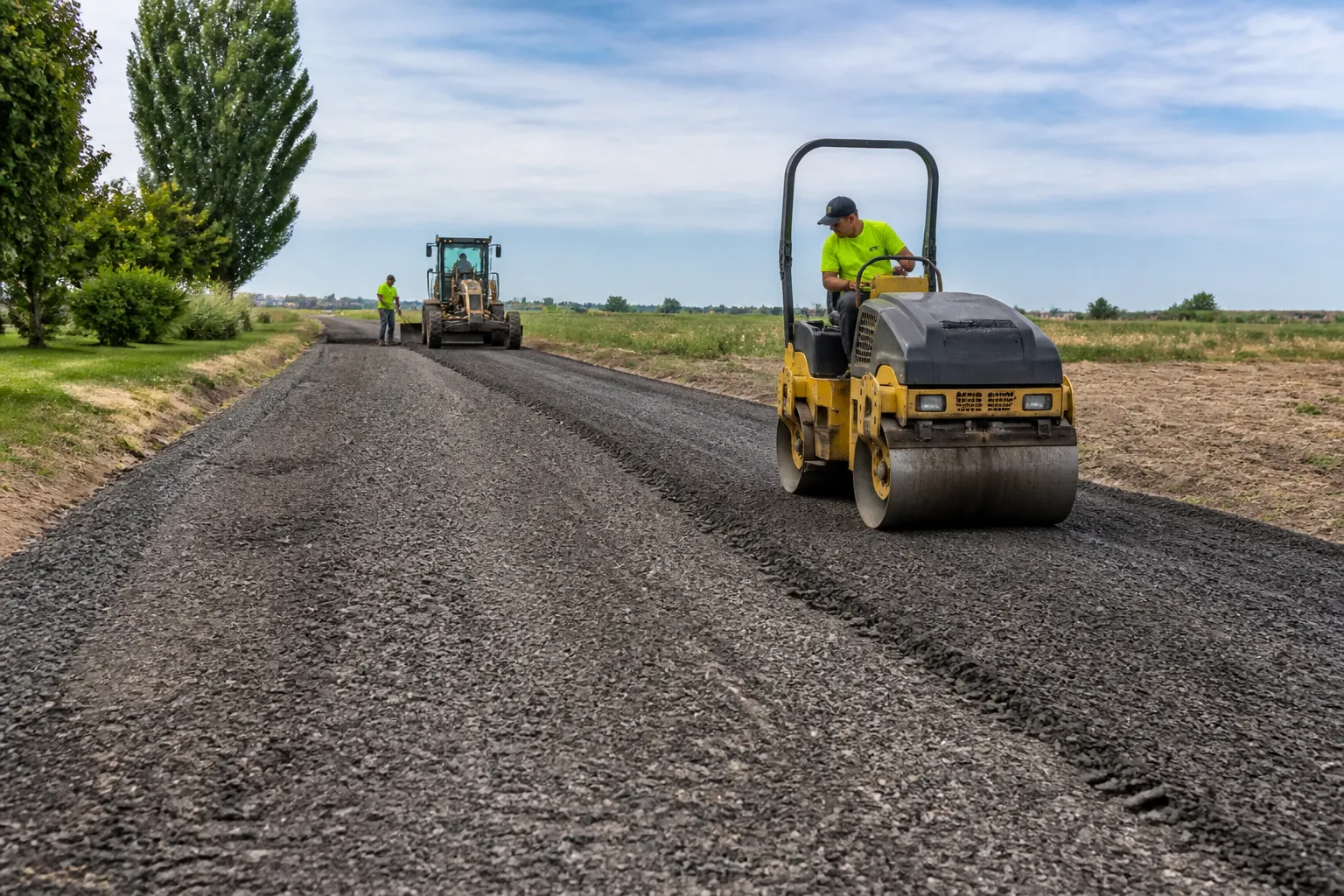
Kennewick Asphalt Paving provides Recycled Asphalt Paving in Kennewick, WA for property owners in Kennewick, WA and the Tri-Cities.
Recycled asphalt paving is appropriate when a property needs a compacted driving surface for a driveway, private lane, rural approach, parking turnout, or access route and the intended use fits the material. Reclaimed asphalt material can provide a practical alternative to loose gravel when the underlying route is prepared and shaped correctly. It is not simply scattered millings. The condition of the base, moisture, traffic, drainage, and compaction all influence the finished surface.
Kennewick Asphalt Paving evaluates recycled asphalt paving projects in Kennewick and the Tri-Cities around the route’s actual use. A home driveway, shop approach, agricultural lane, and equipment access route have different traffic patterns and performance needs. We assess existing ground or pavement, discuss preparation requirements, and explain how a recycled asphalt surface differs from hot-mix asphalt and tar and chip paving.
This material can be a useful option for stable, prepared private-property routes where a firm, compacted surface is desired without selecting conventional smooth asphalt. It may be considered for new access routes, refreshed gravel drives, rural lanes, turnarounds, and locations where the desired finished appearance is more practical than formal.
Recycled asphalt may not be the preferred solution for every application. Formal parking lots, heavily loaded truck areas, routes with significant standing water, and pavement requiring a smooth finished profile may be better served by a different design.
A recycled asphalt surface can improve the driving experience on loose aggregate or worn access areas by creating a compacted layer that is less prone to loose stone movement. It can establish a more defined route, reduce dust and washboarding compared with untreated gravel in some conditions, and improve the appearance of a functional property access area.
Gravel that migrates, develops minor ruts, or becomes difficult to maintain can be a candidate for recycled asphalt after the route has been shaped and supported. The material still relies on a stable base and correct drainage.
Older access paths may need regrading, edge correction, or localized repair before a new recycled asphalt layer is placed. Covering soft spots, standing water, or failed base without preparation only hides the condition temporarily.
We start with a review of the route, intended traffic, existing material, and water movement. Preparation can include grading, excavation of unsuitable material, aggregate base work, and correction of low or weak areas. Recycled asphalt is placed across the prepared footprint, shaped to the planned profile, and compacted for a more cohesive surface.
Material behavior can vary with source composition, temperature, weather, and traffic. A realistic discussion of the site is more useful than treating recycled asphalt as interchangeable with new hot-mix pavement.
Residential use can include driveways, routes to detached garages, RV parking approaches, and longer property lanes. Homeowners often value a driving surface that is more cohesive than gravel but does not need the appearance or use profile of a formal asphalt driveway.
Rural, agricultural, and light-commercial sites may use recycled asphalt for low-to-moderate traffic access routes, shop approaches, equipment turnouts, or property connections. Frequent heavy loads, tight turning, loading operations, and formal customer parking should be discussed carefully when comparing material options.
Scope depends on route size, existing surface condition, excavation needs, grading, base support, drainage, material access, and expected traffic. Edge support and a planned water path are important because material can be displaced at unsupported borders or where runoff crosses the route. The work area should also be checked for utilities, irrigation, gates, and other site features.
Expected results are a compacted, defined driving surface with a practical appearance and improved cohesion compared with untreated loose aggregate. It will not have the uniform, smooth finish of new asphalt, and its appearance can vary. Ongoing drainage problems, heavy loads outside the intended use, and weak base conditions can affect performance over time.
Kennewick and surrounding Tri-Cities properties include wide lots, rural approaches, shop access, and longer private driveways where recycled asphalt may be worth evaluating. We provide site-based recommendations for suitable projects in Kennewick, Pasco, Richland, and nearby communities.
It uses reclaimed asphalt material that is placed, shaped, and compacted to create a practical driving surface.
Yes, when the route has suitable preparation, drainage, and expected vehicle use.
No. It has a different material makeup, appearance, and finished surface character.
Yes. The support below the material and the surface drainage are important to performance.
Failed areas should be evaluated and repaired or removed as needed rather than simply covered.
Heavy truck routes, formal high-traffic parking areas, severe drainage problems, and unstable bases may call for another paving approach.