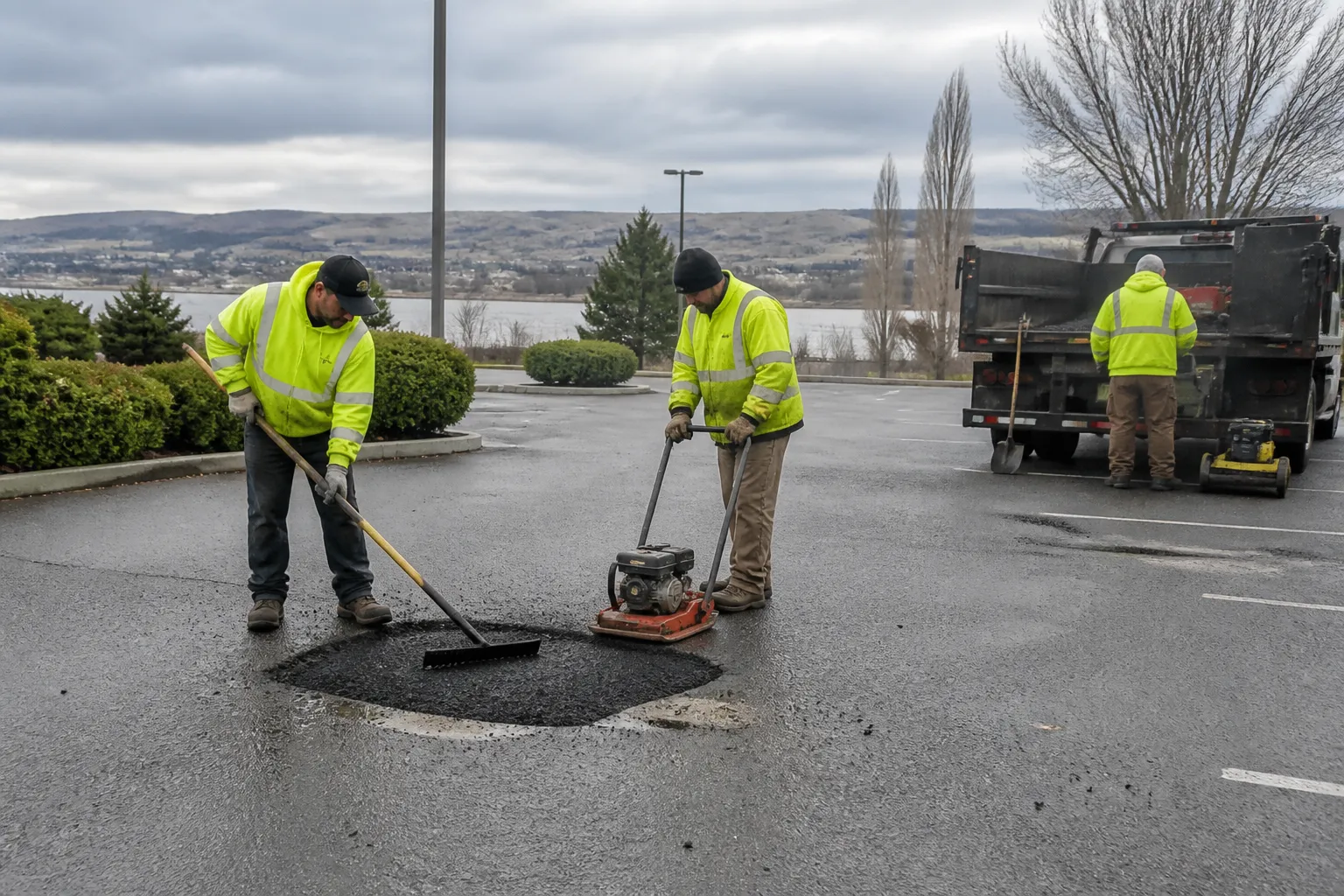
Kennewick Asphalt Paving provides Pothole Repair in Kennewick, WA for property owners in Kennewick, WA and the Tri-Cities.
A pothole is an active pavement failure, not just a shallow dip. It forms when asphalt breaks away from a weakened section, often after water enters a crack or the support below the surface loses strength. Once the hole is open, tires, weather, and loose material can cause it to expand quickly.
Kennewick Asphalt Paving provides pothole repair in Kennewick, WA for driveways, parking lots, access lanes, and private roads. We repair the damaged area by addressing loose pavement and rebuilding the hole with a practical asphalt patch.
A pothole can indicate a single localized issue, but it can also reveal broader pavement deterioration. We inspect the surrounding asphalt to determine whether a focused repair is appropriate.
Home driveways often develop potholes near garage approaches, at the end of the driveway, in wheel paths, or where water has worked into cracks. Repairing the hole can make daily access smoother and help protect surrounding pavement.
At commercial properties, potholes commonly occur at entrances, high-turn locations, drain paths, and busy drive aisles. These areas receive repeated traffic and should be assessed with the full pavement condition in mind.
A single pothole can often be repaired. A surface with many potholes, web-like cracking, broad settlement, or repeat failures in the same location may need more than isolated patches. Depending on the condition, we may discuss asphalt repair, resurfacing, milling, removal, grading, or new paving.
Repair scope depends on the depth and width of the failed area, the stability of surrounding edges, the condition below the asphalt, water movement, access, and the number of potholes. The expected result is a more stable, usable driving surface where loose and broken pavement has been removed. Fresh patches can look darker than older asphalt and may remain visibly distinct.
Yes. Small holes can expand as water and vehicle traffic work on the broken edges.
It can be, but the pavement edge and surrounding support should be assessed first.
Recurring failure can indicate a deeper issue or a wider damaged area that needs further evaluation.
Yes. We can assess multiple damaged areas and develop a practical repair scope.
No. Potholes need asphalt repair before a surface treatment is considered.
Yes. We can review potholes in private access lanes and roads in the Kennewick area.
Call +15094101738 to discuss pothole repair in Kennewick and nearby Tri-Cities communities.