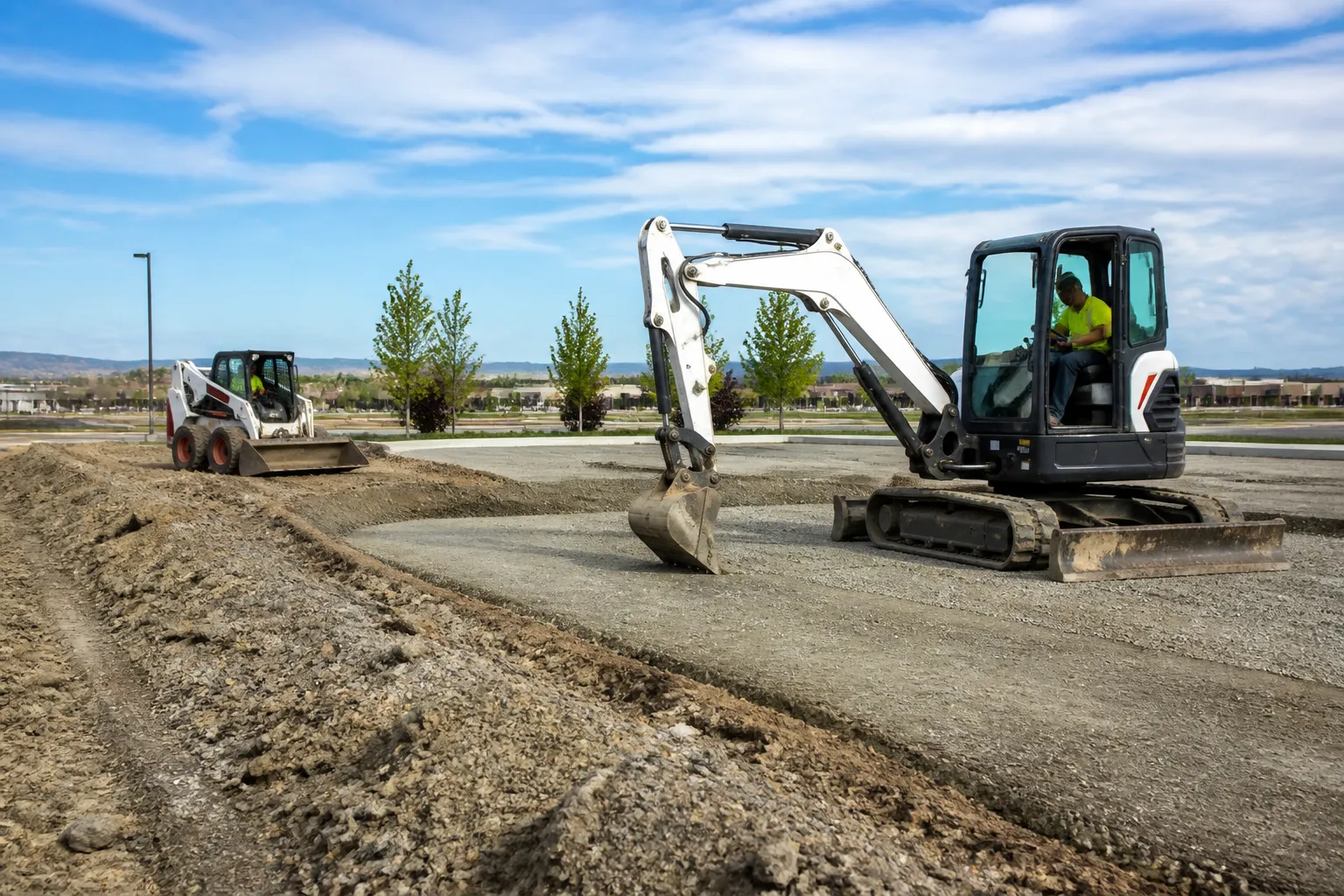
Kennewick Asphalt Paving provides Grading and Excavation in Kennewick, WA for property owners in Kennewick, WA and the Tri-Cities.
Grading and excavation are appropriate when ground beneath a future asphalt surface is uneven, soft, poorly shaped for drainage, or occupied by old pavement and unsuitable material. They are important when a driveway, parking area, or private road needs a new layout rather than a surface treatment. Asphalt performs best when it is placed over a prepared foundation shaped for the property and compacted for the traffic it will receive.
Kennewick Asphalt Paving provides grading and excavation as part of paving and reconstruction projects in Kennewick. This is the stage where the route, elevations, aggregate base, and water movement are addressed before hot-mix asphalt is installed. Careful preparation helps avoid building a fresh surface over the same underlying problem.
Preparation may be needed for a new driveway, private road, parking expansion, replacement pavement, or an area that repeatedly holds water. It can also be appropriate after removing failed asphalt, when old base is unstable, or when planned pavement must connect cleanly with a street, building, garage, gate, or existing concrete.
Minor irregularities do not always require full excavation. Conversely, new asphalt over visibly weak ground does not create durable support. We review the conditions to recommend preparation that fits the project.
Grading establishes the intended shape of a paved area. Excavation removes material where planned grade, base depth, or condition requires it. Together, they can correct erratic elevations, provide room for aggregate base, improve transitions, and direct surface water away from vulnerable pavement where site conditions allow.
Soft soil, loose fill, saturated pockets, and broken pavement can leave uneven support beneath asphalt. Removing unsuitable material and rebuilding the working area with aggregate creates a more consistent platform.
Water can enter pavement through cracks, collect in low areas, or erode support near an edge. Grading can provide a usable slope or crown so water is less likely to remain on finished asphalt. A broader drainage issue may require coordination outside the paving scope.
Work begins with pavement boundaries and intended finished elevations. We evaluate access, visible soil, existing asphalt, and features such as buildings, fences, trees, curbs, utilities, and irrigation. Equipment removes old pavement or soil as needed, shapes the subgrade, and prepares the footprint for base installation.
The amount of excavation, aggregate, and compaction varies with the site and intended loading. It should not be assumed from finished square footage alone.
Residential work often supports new or replacement driveways, long approaches, RV pads, shop access, and paved areas around detached structures. Common concerns include irrigation water, a steep street transition, or a route that has become uneven after years of use.
Commercial applications can include parking expansions, equipment yards, private service roads, loading access, and pavement failure under heavier traffic. Equipment access, deliveries, drainage around buildings, and keeping part of a site functioning can shape the work sequence.
Grading is closely tied to existing elevations. A project may need to preserve a building threshold, meet a concrete slab, work around a gate, or avoid directing water toward a neighboring property. Utility locations, buried irrigation, drainage features, and property boundaries should be identified before excavation. Driveway work within a public right-of-way may have local requirements.
Haul-off, room for equipment, old pavement depth, and distance to a disposal or staging area can affect logistics. An on-site assessment is more informative than a generic per-square-foot assumption.
Finished grading and base work should provide a shaped, compacted foundation ready for asphalt, with controlled elevations and better-planned transitions. It cannot guarantee that all future ground movement or drainage issues disappear. Seasonal moisture, heavy loads, underground work, and drainage outside the footprint can still affect pavement.
The durable benefit is that asphalt begins on a foundation designed for the project rather than covering an obvious low spot or weak material. That is valuable when building a new paved area or correcting a failure that began below the surface.
Kennewick and Tri-Cities properties often combine open lots, private access, irrigation, garages, shops, and varied grades. We evaluate the paving footprint and surroundings before recommending preparation for projects in Kennewick, Pasco, Richland, and nearby communities.
Not all need the same amount, but new paving commonly requires preparation for stable base and intended finished grade.
It can improve surface shape in the work area. The broader property drainage path still needs consideration.
Compacted aggregate provides a stable, drainable layer between prepared ground and the asphalt surface.
Yes. Removal and excavation can be part of replacement paving when existing pavement or support is failing.
Utility information, irrigation components, property features, and other buried or fixed items relevant to the work area should be identified.
It can be. A smaller driveway still needs workable elevations, drainage, and support for the vehicles using it.