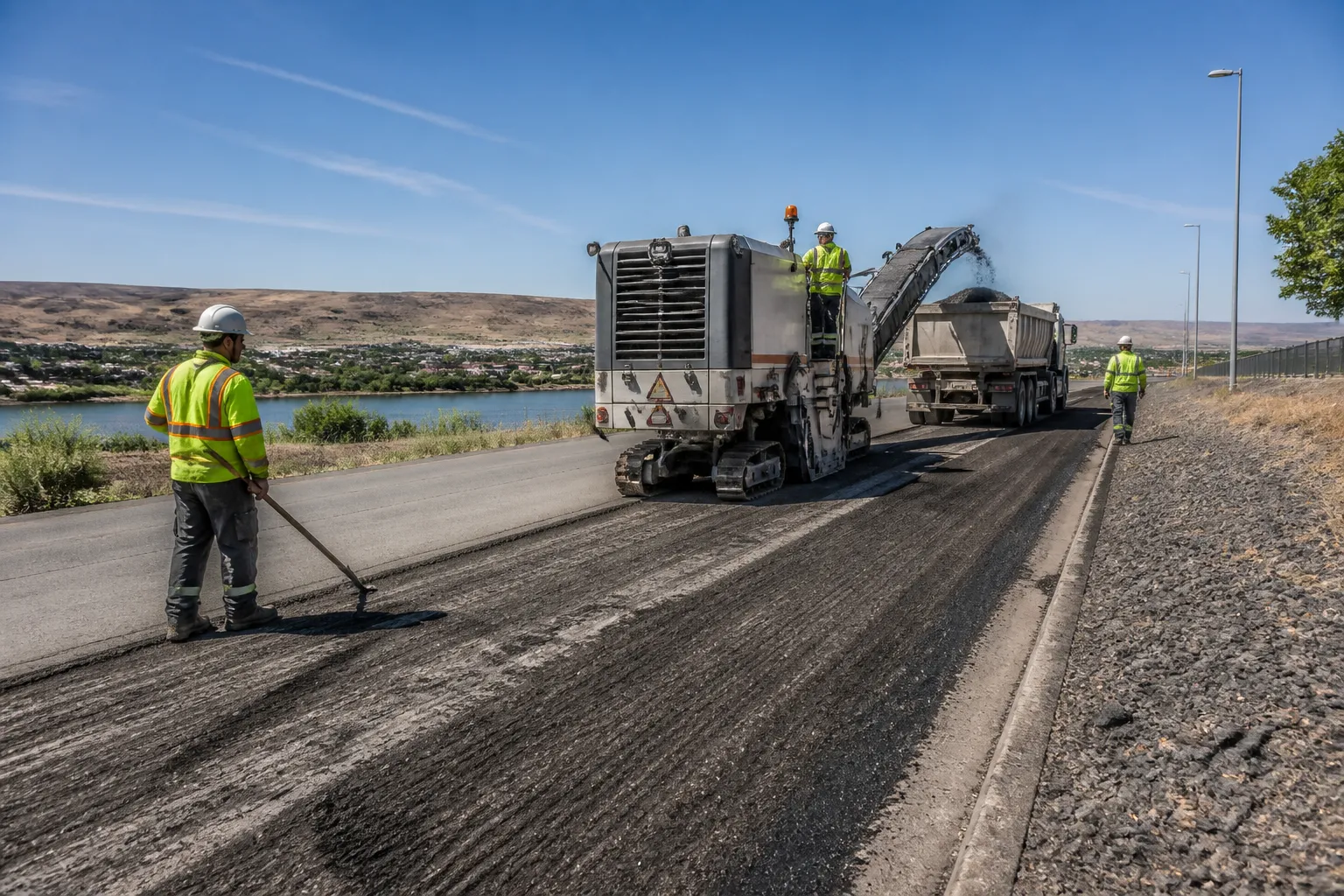
Kennewick Asphalt Paving provides Roadway Repair in Kennewick, WA for property owners in Kennewick, WA and the Tri-Cities.
Roadway repair is appropriate when a paved private road, shared lane, industrial access route, or neighborhood connection has localized failures that make travel rough or hard on vehicles. A pothole, sunken patch, broken road edge, or cluster of cracks is more than a surface blemish. Each opening gives water and traffic a route into the pavement structure, where damage can widen beyond the spot that first drew attention.
Kennewick Asphalt Paving evaluates roadway damage in the context of how the route is used. A lightly traveled residential lane needs a different repair plan than a commercial yard entrance carrying delivery trucks. In Kennewick and across the Tri-Cities, dry summers, seasonal moisture, irrigation runoff, and repeated vehicle loading can all expose weak areas in older asphalt. The objective is a stable, navigable section while being clear about what a targeted repair can and cannot correct.
Repair is often practical when most of the road remains stable and failures are limited to identifiable sections. It can address potholes, contained alligator cracking, failed patches, raveling asphalt, edge breaks, settlement at entrances, and low areas that hold water after rain or irrigation.
When cracking, deformation, and base failure extend through most of the roadway, repeated spot repairs may only postpone a broader decision. We identify that distinction rather than presenting a patch as a full-road cure.
A properly scoped repair removes unstable asphalt and addresses support immediately beneath it before a new patch is placed. This can eliminate loose material, reduce a jarring transition, restore a smoother travel line, and close an opening where water can work downward. It can also rebuild a damaged edge so the pavement has a defined boundary.
Delivery vehicles, farm equipment, trailers, and frequent turning concentrate stress in specific locations. Intersections, gate approaches, dumpster routes, and loading entrances often fail before a straight roadway section. These areas may need a footprint larger than the visible hole so the new work reaches stable material.
Persistent runoff across an edge, a depressed wheel path, or water trapped beside a patch can soften support and accelerate breakup. Repair may improve the rebuilt area, but a property-wide drainage problem can require separate grading or drainage coordination.
Roadway repairs are not handled by pouring new mix into loose asphalt. We mark an area beyond crumbled edges, remove failed pavement, clear unsuitable material, and assess whether the exposed base needs rebuilding or re-compaction. A stable aggregate base is placed or corrected where needed. Fresh hot-mix asphalt is installed to the planned thickness, shaped to meet adjoining pavement, and compacted.
Crack filling can be useful on sound adjacent pavement, but it is not a substitute for full-depth repair where asphalt has already broken apart.
Residential repairs may involve a shared private lane, a long driveway serving several homes, or a paved approach to a shop. Access, parking, mail delivery, gates, and landscaping affect how the work is planned. Commercial and industrial sites may need work at truck routes, employee access roads, service entrances, storage-yard connections, or association-owned roads. Traffic control, work sequencing, turning movements, and keeping a route usable are meaningful scope considerations. High-load failures can call for deeper reconstruction than a passenger-car lane.
A well-executed repair should leave the failed location solid, compacted, and easier to drive through, with a defined connection to surrounding asphalt. New asphalt is darker than an aged road, and a patch joint remains visible. Repairing one section does not erase existing cracks, oxidation, drainage problems, or weaknesses elsewhere.
Scope depends on the number of failures, depth of deterioration, equipment access, base condition, edge support, drainage patterns, and whether traffic must be maintained. An on-site look is the reliable way to distinguish a surface patch from an area that needs deeper work.
Local roadway repairs often involve private access rather than municipal streets. We work on property-owned routes in Kennewick, Pasco, Richland, and nearby Tri-Cities communities. Pavement within a public right-of-way or tied to a utility project may be subject to agency requirements and timing.
If asphalt around the hole is loose, cracked, or soft under traffic, repair usually needs to extend through failed pavement rather than cover the top.
Yes, when surrounding pavement and the base beneath it remain stable.
New asphalt has a darker color and visible seams. The aim is a durable transition, not an invisible color match.
Limited edge support, water exposure, and vehicles traveling close to the pavement edge can contribute.
A localized depression can sometimes be rebuilt. Larger drainage patterns may need grading or another site-level solution.
They often do. Road length, shared access, regular traffic, and keeping users moving through the site add planning considerations.