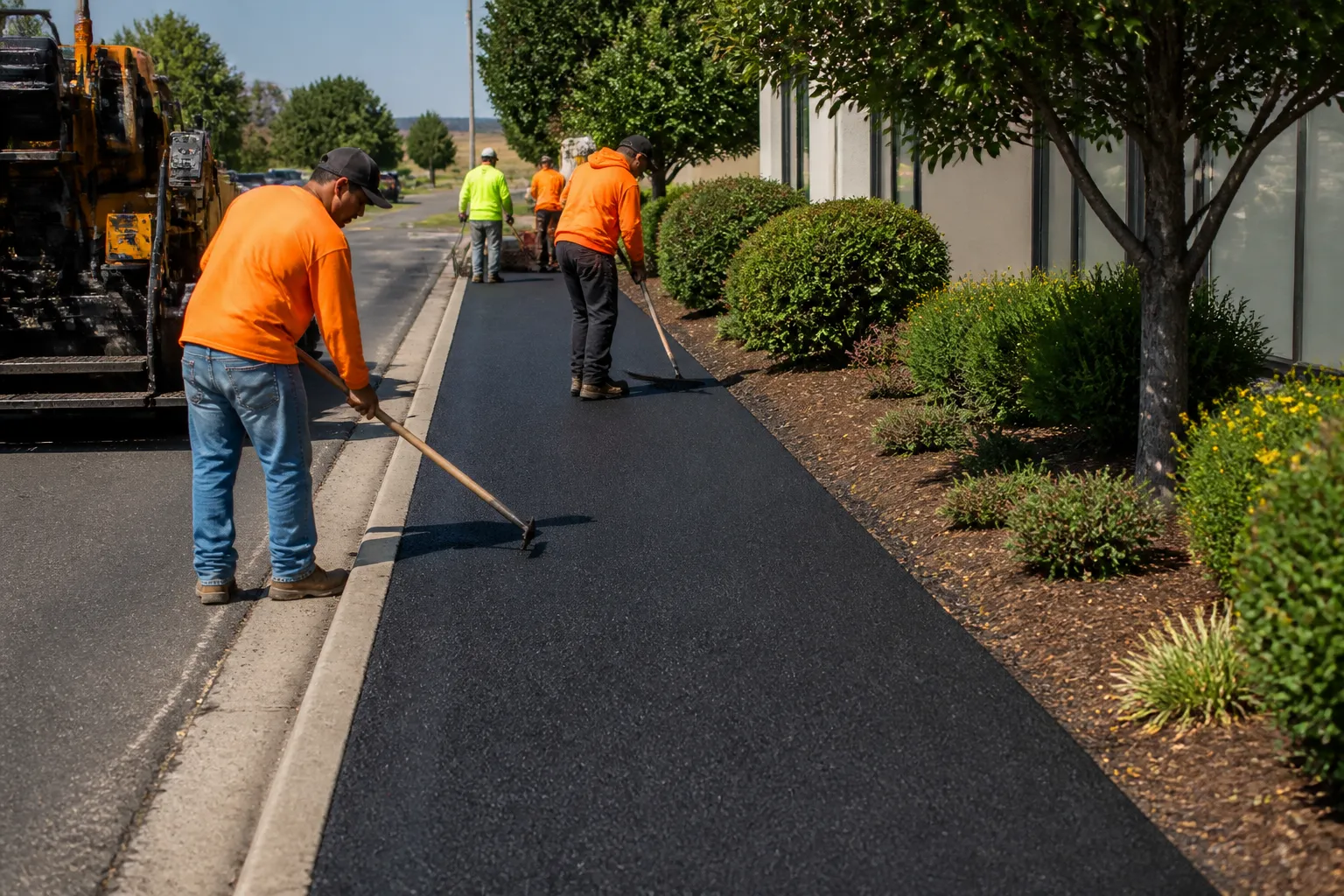
Kennewick Asphalt Paving provides Asphalt Sidewalk Installation in Kennewick, WA for property owners in Kennewick, WA and the Tri-Cities.
Asphalt sidewalk installation is appropriate when people need a defined, durable walking route between parking, entrances, homes, outdoor areas, or work spaces. A path across bare ground can become muddy, uneven, dusty, or difficult to use after irrigation and seasonal weather. A damaged existing walkway may have cracks, settled areas, broken edges, or abrupt transitions that make it less comfortable for pedestrians.
Kennewick Asphalt Paving installs practical asphalt sidewalks and walkways for suitable properties in Kennewick and the Tri-Cities. The work begins with how people will use the route. A short connection from a driveway to a side door is different from a longer route through a multifamily property, business frontage, or outdoor gathering area. We consider the route, grade, water movement, adjacent surfaces, and the condition of the ground before recommending a paving scope.
Asphalt can be a useful walkway material where a smooth, continuous pedestrian route is needed and the property benefits from flexible paving connections. It is often considered for new paths, replacement of failing asphalt walks, and practical connections beside driveways, garages, shops, parking areas, and recreation spaces.
For locations governed by accessibility requirements, municipal standards, or public-right-of-way rules, dimensions, slopes, curb transitions, and permits may need to be determined before construction. We focus on appropriate private-property paving work and evaluate site conditions within that scope.
A new path creates a visible travel line and a more stable walking surface than loose material or compacted soil. It can reduce tracked-in dirt, eliminate small surface obstacles, and create a cleaner connection between portions of a property. Replacement work can remove unstable asphalt and rebuild the walking route on a prepared base.
Settlement, exposed aggregate, worn edges, and mismatched elevations can make an old path awkward to use. Preparation allows the new walkway to meet driveways, patios, entrances, or existing pavement with more deliberate transitions.
Water that ponds beside or crosses a sidewalk can soften supporting material and make the area less inviting. The proposed path is reviewed in relation to visible grades and runoff. A walkway project can improve the route itself, but a larger site drainage concern may require separate work.
Good asphalt sidewalks start below the finished surface. The route is laid out, and the work area is excavated or shaped as needed to allow for a compacted aggregate base and asphalt. Unsuitable material is removed where conditions call for it. The base is placed and compacted, then hot-mix asphalt is installed and compacted to create the planned surface.
The exact base depth, asphalt thickness, and width depend on the route, ground condition, connections, and expected use. Pedestrian-only paths are planned differently from paths that may also receive occasional maintenance equipment.
Residential projects can include a front-entry connection, side-yard route, path to a detached garage, pool-area walk, or a walking line beside a driveway. Gates, landscaping, irrigation, steps, and existing concrete are important considerations when planning a route.
Commercial and multifamily properties may need walks connecting parking areas, service areas, office entries, common outdoor spaces, or building entrances. In these settings, pedestrian traffic, delivery activity, drainage, access during construction, and any applicable property standards can affect the sequence and final layout.
Scope can be affected by route length and width, excavation needs, soil and base condition, drainage, existing pavement removal, obstacles, and equipment access. A narrow path behind a building may have different logistical needs than an open route along a parking area. An on-site review helps establish the work limits and identify relevant transitions.
Expected results are a defined asphalt walkway with a smoother, more consistent surface for normal pedestrian use. New asphalt will appear darker than surrounding aged pavement, and seams where it meets other surfaces are expected. A new path does not correct unrelated settlement, drainage problems beyond the work area, or conditions caused by later utility excavation.
Kennewick properties often combine driveways, open yards, garages, irrigation, shops, and outdoor living areas that benefit from clear walking connections. We provide asphalt sidewalk installation for appropriate private-property projects in Kennewick, Pasco, Richland, and nearby Tri-Cities communities.
Yes. The route and transition can be planned so the walkway connects practically with the existing paved area.
A compacted base is commonly needed to provide more consistent support beneath the asphalt surface.
Yes. When failure is widespread, removal and new installation may be more practical than repeated patches.
It can provide a defined route through that area, but broader drainage or irrigation conditions may still need attention.
Yes. These are common private-property applications when the route and surrounding elevations are suitable.
Intended pedestrian use, space available, existing connections, property requirements, and whether equipment must use the route all matter.