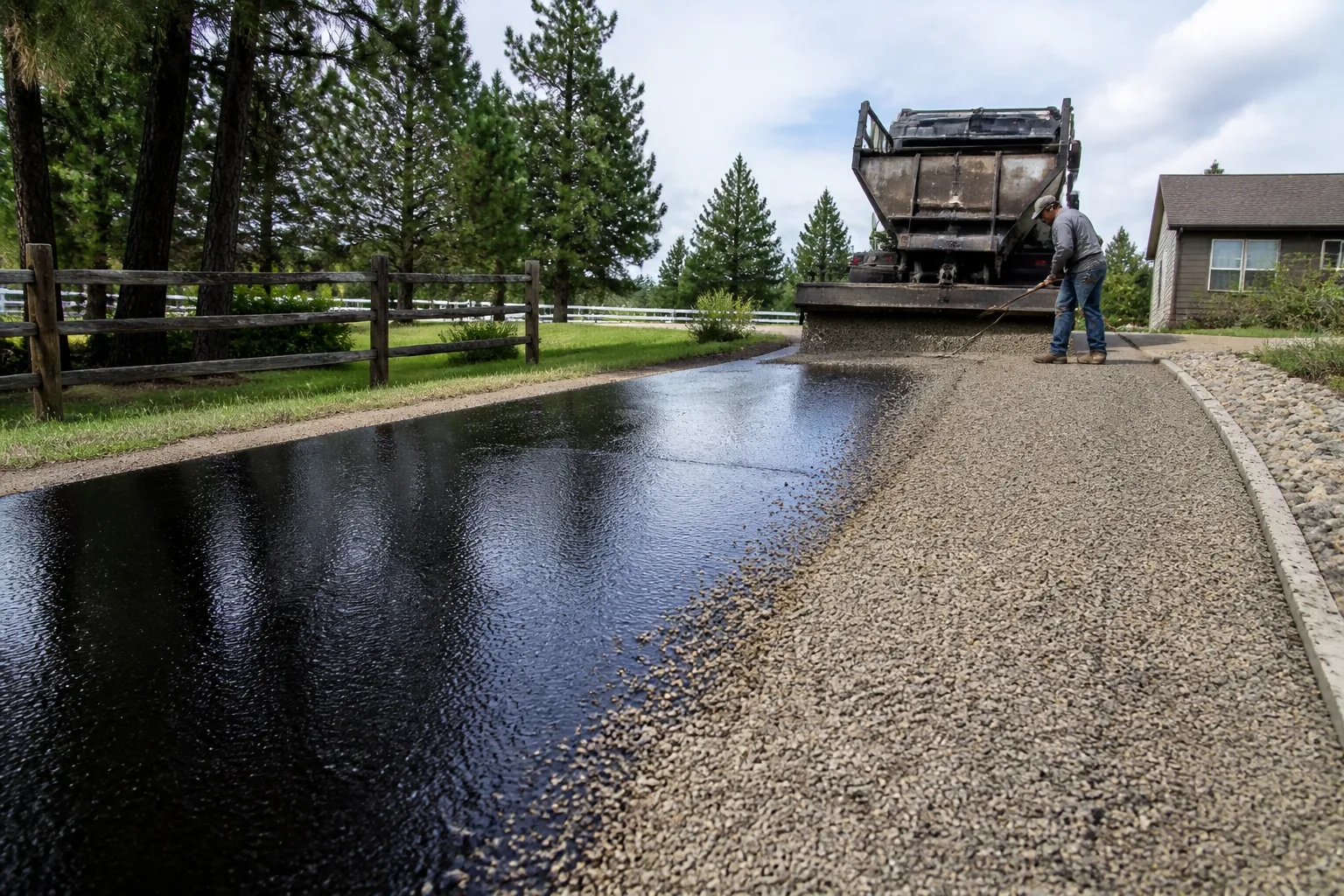
Kennewick Asphalt Paving provides Tar and Chip Paving in Kennewick, WA for property owners in Kennewick, WA and the Tri-Cities.
Tar and chip paving is appropriate for property owners who want a textured, stone-finished driving surface rather than conventional smooth asphalt. It is commonly considered for residential driveways, rural approaches, private lanes, and low-to-moderate traffic access routes. The finished surface has a distinct appearance and driving feel, but its success still depends on the route beneath it, including base condition, drainage, edges, and the type of traffic that will use it.
Kennewick Asphalt Paving evaluates tar and chip paving projects in Kennewick and the Tri-Cities based on the existing surface and intended use. A long country drive, a parking turnout, and a delivery route do not place the same demands on a surface. We discuss whether a tar and chip treatment fits the property, what preparation is required, and when standard asphalt or another paving approach may be more practical.
Tar and chip may suit a property that needs a finished driving surface with visible aggregate and a less uniform appearance than black asphalt. It can be considered for a stable existing base, a prepared gravel route, an older paved surface that is suitable for the treatment, or a new private access route built with proper support.
It is not the automatic answer for every paved area. High-turning commercial traffic, unstable bases, extensive potholes, and severe drainage problems may call for repair, reconstruction, or conventional asphalt instead.
Tar and chip paving combines a binder application with selected stone aggregate. The aggregate is spread into the binder and rolled so it becomes the visible wearing surface. This produces a textured finish that can provide traction and a natural aggregate appearance. The finished surface is not intended to look or perform exactly like smooth hot-mix asphalt, and that difference should be part of the decision.
The exposed chips create visual variation and a rougher texture than asphalt. Aggregate selection influences color and overall appearance. Traffic and weather can naturally alter the appearance as the new surface settles into regular use.
A binder and stone finish does not repair deep base failure or cure water that is trapped on a route. Soft areas, broken pavement, poor edges, and major low spots need to be identified before the surface treatment is considered.
Planning starts with the route, its current condition, and access for equipment. Preparation can include grading, base correction, removal of failed pavement, and repairing localized weak areas. Once the surface is ready, the binder is applied and clean aggregate chips are distributed across it. Rolling seats the stone into the binder and helps create the finished texture.
Exact materials and preparation depend on the surface being treated and the intended traffic. A site assessment is more reliable than choosing a paving method only from a photograph.
Tar and chip is often considered for residential driveways, longer rural approaches, and private routes to shops, garages, or acreage. It can provide a defined driving path while retaining a more aggregate-forward appearance than standard asphalt. Gate locations, drainage, slopes, and turning areas should be part of planning.
For commercial properties, tar and chip is generally best evaluated case by case. Low-speed private access or limited-use areas may be candidates, while truck-heavy yards, loading zones, frequent tight turns, and formal parking layouts may be better suited to other paving methods. We explain the tradeoffs based on actual use.
Project scope depends on route dimensions, base condition, existing pavement, grading, drainage, edge support, aggregate selection, equipment access, and traffic. New construction requires a prepared base. Existing asphalt must be stable enough for the planned work, and severe failed areas should not simply be covered.
Expected results are a consistent, textured stone surface with a distinct finished appearance and a practical driving route. Loose aggregate can occur during the early period after installation, and the surface will not have the smooth, solid-black look of conventional asphalt. Ongoing water problems, heavy use beyond the planned traffic, and unsupported edges can shorten surface performance.
Across Kennewick and the Tri-Cities, private properties often include longer drives, open lots, shop access, and rural-style routes where a textured alternative may be worth considering. We provide on-site evaluations for suitable tar and chip paving projects in Kennewick, Pasco, Richland, and nearby communities.
It is a surface created by applying binder and embedding stone aggregate, leaving a textured, visible-chip finish.
Yes, it can be a suitable driveway option when the base, drainage, and expected traffic support the project.
No. Tar and chip has exposed stone texture and a different appearance and feel from hot-mix asphalt.
Yes. The existing material must be assessed and prepared to provide stable support for the new surface.
Failed areas should be repaired or reconstructed as needed first. A surface treatment does not replace proper support.
Yes. Standing water and poor edges can affect the route, so grade and drainage are part of the site assessment.