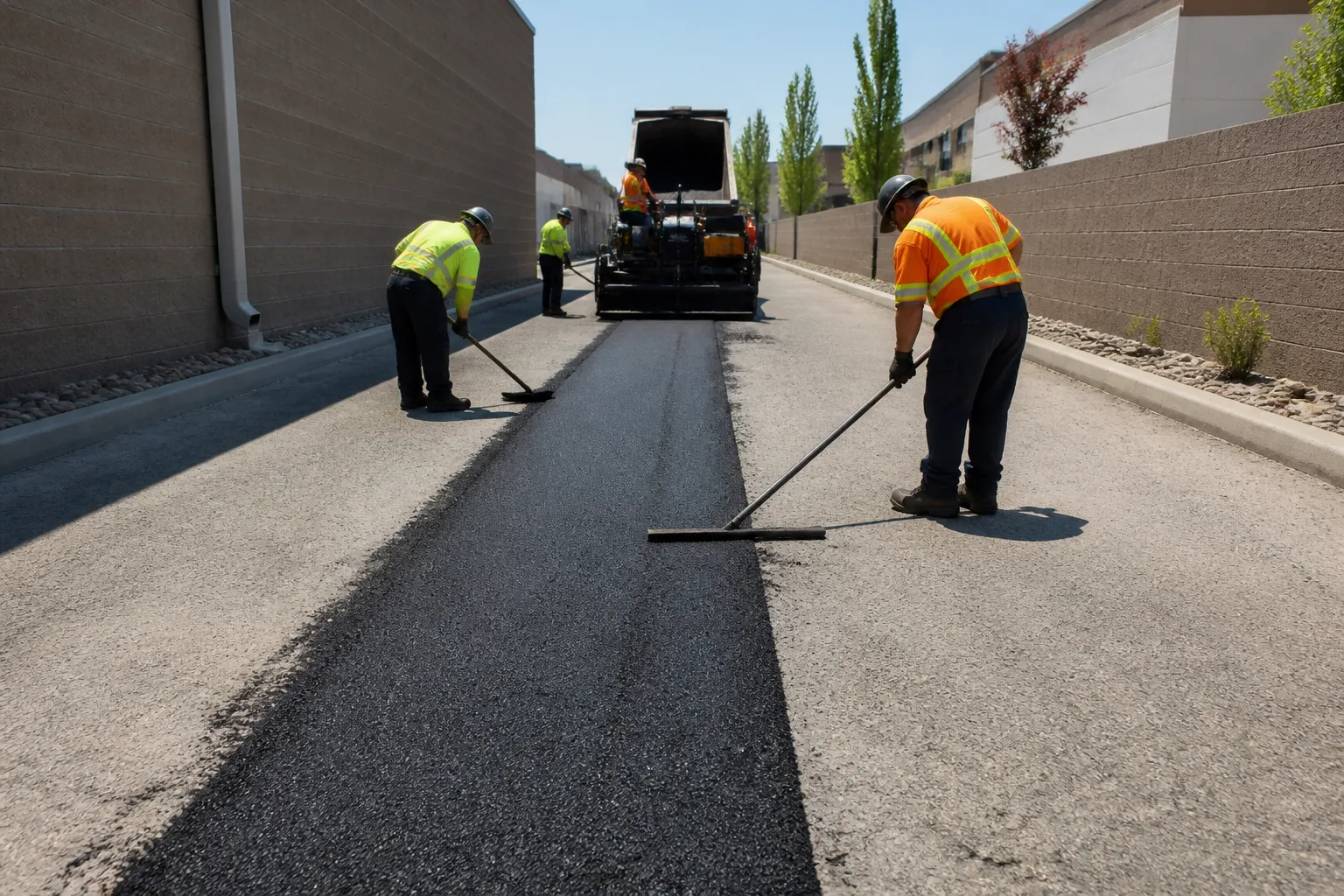
Kennewick Asphalt Paving provides Trench Paving in Kennewick, WA for property owners in Kennewick, WA and the Tri-Cities.
Trench paving is a focused asphalt restoration service for long, linear pavement cuts left after underground work. It is appropriate when a completed trench crosses or follows a private road, driveway, access lane, parking area, or service route and the disturbed zone needs a durable paved surface again. Although it can resemble a small patch, trench paving has its own planning needs because the repair follows a continuous line through pavement.
Kennewick Asphalt Paving considers the full restoration path, not only its most damaged spot. A narrow trench may cross wheel paths, parking rows, turning areas, or an entrance where a change in height is quickly felt. In Kennewick and the Tri-Cities, the finished result depends on stable backfill, clean pavement edges, appropriate asphalt placement, and a route that can accommodate traffic.
Trench paving is used after below-ground utility or site work is complete and a linear excavation has been backfilled. It can fit a short driveway crossing, a long utility run parallel to an access road, or a section through a commercial parking lot. It is especially useful when temporary gravel or cold patch no longer provides a smooth, practical surface.
For one localized excavation or failed opening, utility cut repair may be a better description. Trench paving is most useful when restoration is defined by a continuous cut and the quality of the full seam matters.
The service restores continuity after pavement has been opened. It can replace temporary material, remove fractured asphalt along trench margins, improve the ride across a crossing, and reduce exposed seams where water can enter. It gives the repaired corridor an intentional surface rather than leaving an irregular strip that continues to wear under traffic.
A trench can be stable at one end and weak at another. Low locations, turns, gate approaches, and building entrances may need different preparation than a straight, lightly used portion. Reviewing the full line avoids treating varied conditions as one uniform repair.
Trench paving rebuilds the disturbed strip. It does not erase broad cracking, oxidation, or base failure in the rest of a lot or road. If adjoining pavement is near the end of its useful condition, localized restoration may need to be considered alongside a larger plan.
Good trench paving begins with a stable trench top and clear repair boundary. Loose asphalt at the sides is removed, and restoration width is set so new asphalt meets firm material instead of ragged edges. Backfill is evaluated at the surface; if correction or compaction is needed within the paving scope, it is addressed before the top course is installed.
Fresh asphalt is generally darker than surrounding aged pavement. Weathering reduces color difference over time, but the linear seam remains a normal feature.
Residential trench paving often follows water, sewer, electrical, gas, or irrigation work across a driveway or private lane. Work is planned around vehicle access, garage approaches, gates, landscaping, and nearby concrete. A short crossing can require careful elevation work where cars transition from the street.
Commercial applications include utility routes through parking lots, service drives, warehouse approaches, multifamily access lanes, and equipment yards. These can involve longer restoration distances, heavier wheel loads, traffic-management needs, and markings that must be re-established after paving. The work sequence should reflect how the property operates.
Scope depends on trench length and width, pavement thickness, trench support, condition of adjacent asphalt, access for paving equipment, drainage, crossings, and traffic. A narrow corridor may still have meaningful complexity when it passes through a turning lane, loading entrance, or shared drive. On-site review helps establish restoration limits and clarify whether striping, broader patching, or nearby pavement work is relevant.
Expected results are a compacted, usable asphalt corridor that reconnects the route and provides smoother vehicle crossings. New material will not perfectly blend with weathered pavement, and a seam at the repair edges is expected. It also cannot prevent future movement caused by unstable backfill, leaks, or subsequent utility access.
Kennewick properties frequently combine private drives, service areas, irrigation, and utility access that can require linear pavement restoration. We serve appropriate private-property trench paving projects in Kennewick, Pasco, Richland, and nearby Tri-Cities communities. Public right-of-way restoration may be controlled by a utility provider or local agency.
Trench paving restores a continuous linear excavation, while a standard patch usually addresses a contained failed area.
Work sequencing depends on access, trench readiness, traffic needs, and the restoration layout. These factors are reviewed on site.
Weak edges, settlement beneath the cut, water entry, and traffic can all stress pavement alongside the trench.
Yes. A completed, stable trench crossing through a residential driveway is a common application.
Yes. If the trench affected stall lines or directional markings, striping can be discussed after asphalt restoration.
It restores the trench corridor. Widespread pavement failures outside that corridor may need separate repair or paving work.